The Research Open Lab for Emergent Strategy (ROLES) at the University of Tokyo's Research Center for Advanced Science and Technology organized a delegation of research group chairpersons in September to conduct strategic and policy dialogues with Hungarian government agencies and research institutions. This marked ROLES' first delegation visit to Hungary. The delegation members were as follows:
Satoshi Ikeuchi, Professor, Research Center for Advanced Science and Technology, The University of Tokyo (ROLES Representative)
Shin Kawashima, Professor, Graduate School of Arts and Sciences, The University of Tokyo (Chair, Research Group “The Internal Logic of Eurasian Regions”)
Atsuko Higashino, Professor, Faculty of Humanities and Social Sciences, University of Tsukuba (Chair, Research Group “The Future of Freedom and Democracy in Eastern Europe, Central and Eastern Europe, and the Balkans”)
Norito Kunisue, Specially Appointed Professor, Research Center for Advanced Science and Technology, The University of Tokyo
Yu Koizumi, Associate Professor, Research Center for Advanced Science and Technology, The University of Tokyo (ROLES Vice-Representative)
Tsuyoshi Goroku, Associate Professor, Faculty of International Politics and Economics, Nishogakusha University (Chair of the “Survey on Foreign Policy and Security (SAFER)” Project)
Yusuke Ishikawa, Researcher / Digital Communication Officer, Institute of Geopolitics (IOG)
This visit to Hungary took place over two days, September 8-9. Below is a summary of the main discussions.
Discussion with Ugrosdy Marton, Deputy State Secretary of the Prime Minister's Office (September 8)
The first day of research on September 8 began with a meeting with Ugrosdy Marton, an advisor to Prime Minister Viktor Orbán. We gained insight into the Hungarian government's perspective on Russia and China's positioning in Hungary, the outlook for the Ukraine war, and Hungary's stance within NATO. Particularly noteworthy for ROLES was the impression that Hungary, often perceived as “pro-China” or “pro-Russia,” is subjectively attempting to build relationships with major powers based on its own realism.
Visit to the National University of Public Service (Ludovika University of Public Service) (9/8)
Subsequently, the delegation visited a think tank gathering Hungarian researchers and policy practitioners, as well as the National University of Public Service (Ludovika University of Public Service: LUPS), which provides education and training for civil servants. They engaged in strategic and policy dialogue with the university's Directorate General for International Affairs (NFI) of the Ludovika University of Public Service) and the affiliated think tank, the John Lukacs Institute for Strategy and Politics.
A distinctive feature of the statements made by researchers and practitioners from universities and think tanks on the Hungarian side was their perspective on Hungary's stance regarding the Russia-Ukraine war. They tended to view it not primarily as an issue of norms or international order, but rather as a matter concerning Hungary's own national political interests. The Hungarian side showed a tendency to perceive international relations with Ukraine as an extension of domestic social issues within Hungary, framed from a nationalist viewpoint. Hungary's strong dissatisfaction regarding the treatment of the Hungarian minority in Ukraine was frequently mentioned.
Conversely, Hungary's relationship with Russia was described as grounded in realism, largely due to its heavy dependence on Russian energy supplies. This stood in contrast to the characterization of its (strained) relationship with Ukraine as being based on “emotion.”
A summary of the roundtable published by the John Lukács Center for Strategic Studies at the National University of Public Administration is available below.
Roundtable Scene
Participants included Yusuke Ishikawa, a researcher at the Institute of Geopolitics currently conducting research in Central Europe, and embassy staff.
Professor Satoshi Ikeuchi and Ambassador Hideko Ono
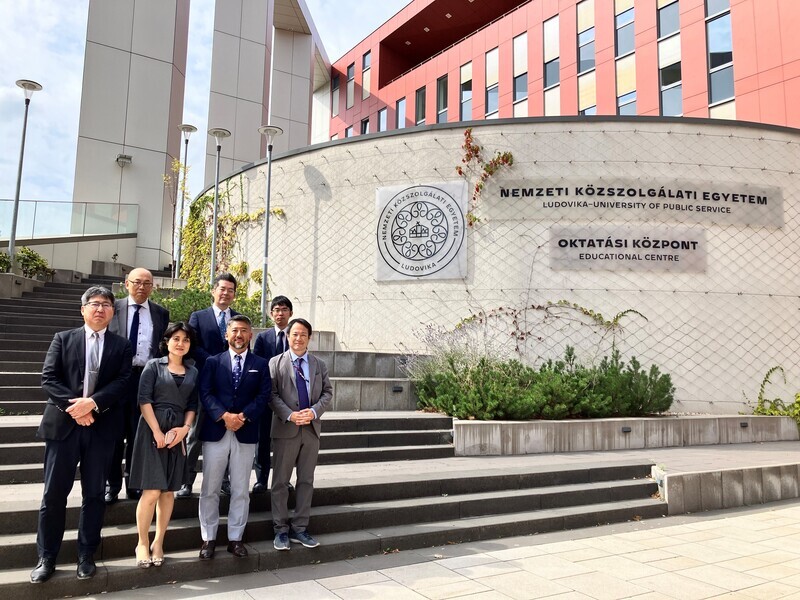
At the main gate of the National University of Public Administration
Visit to the Hungarian Institute of International Affairs (HIIA) (9/9)
On the second day of the visit, the delegation visited the Hungarian Institute of International Affairs (HIIA) for a policy and strategy dialogue in a roundtable format. In addition to HIIA researchers, experts from local think tanks and Ukrainian think tanks participated. Discussions were held with the ROLES delegation to align perspectives on the international situation and assessments from each participant's standpoint.
Similar to Day 1, the Hungarian side raised the Russia-Ukraine war as a key agenda item. The views expressed here showed strong commonality with those at the National University of Public Administration, emphasizing strong dissatisfaction with the treatment of ethnic Hungarians in Ukraine and the reality of energy dependence on Russia.
Regarding relations with Asia, skepticism was expressed towards the notion that “if Russia succeeds in its invasion, it will spread to Asia.”
Commemorative photo during the meeting with HIIA executives: Director and Chairman Gladden Pappin, Chief Advisor and Senior Researcher László VASA, and others
Following Hungary, the delegation visited Estonia (September 10-11), holding multiple roundtables with local think tanks. Hungary and Estonia demonstrated strikingly contrasting positions regarding perceptions of Russia and Ukraine. Closed-door roundtables provided opportunities for the delegation to deepen and diversify its understanding of European perceptions, as experts from each country presented their unique assessments and viewpoints.
During meetings and discussions in Hungary, when asked whether “Hungary occupies a unique or isolated position within Europe,” the common response from the Hungarian side was an assertion that Hungary's position is not necessarily isolated, but rather that it could become mainstream in the next phase or era. It was also striking that various experts clearly asserted, each in their own way, that Hungary's position is neither peculiar nor minority. This is because Hungary's stance aligns with the rising, majority forces in global politics—including those from the so-called “Global South” outside Western Europe—as well as influential forces aligned with U.S. conservatives and the Trump administration.
We extend our deepest gratitude to Ambassador Hideko Ono (at the time) of Japan to Hungary, who not only invited the ROLES delegation to Hungary and provided behind-the-scenes support for the trip, but also participated in the roundtable discussions amidst her busy schedule to convey the significance of the visit to the Hungarian side, as well as to all staff members of the Japanese Embassy in Hungary, including Researcher Natsuki Shinoki.




.jpg)






 Research Unit on the New Persian Gulf Order