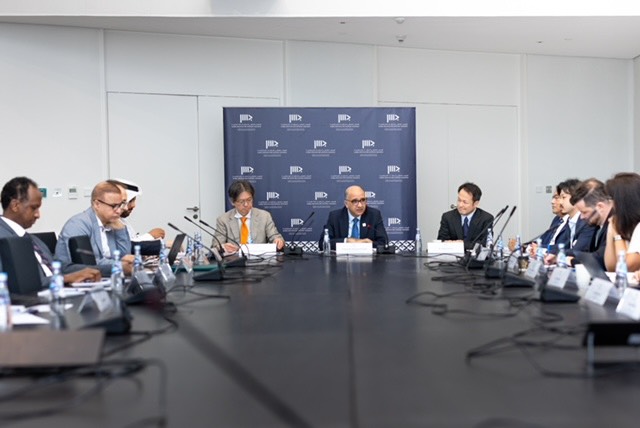
Against the backdrop of today’s conflicts in which information and facts are increasingly distorted through cognitive warfare and mid/disinformation, the symposium aimed to examine how two long-term practices—historical documentation and diplomacy—can contribute to safeguarding truth and human dignity. Discussions were structured around the respective experiences of Japan and Qatar.
Participants from Japan included Prof. Satoshi Ikeuchi, Professor at RCAST and Founding Director of ROLES; Koki Shigenoi, Associated Researcher at RCAST and Associate Member of ROLES; Hidenori Watanabe, Professor at the Interfaculty Initiative in Information Studies, The University of Tokyo; and Ryuichiro Takeshita from Tokyo Broadcasting System (TBS). Session 1: The Battle for Truth in Palestine: Information Warfare and Documentation The first session explored how information manipulation and disinformation have shaped—and distorted—international perceptions and narratives surrounding Palestine. The discussion focused on the mechanisms of disinformation and the challenges faced by journalists and researchers in conveying realities on the ground. Ryan Takeshita (TBS) reflected on media coverage related to Hiroshima and drew comparisons with journalistic practices in Japan and the Middle East. His intervention highlighted how historical memory, reporting practices, and political contexts interact in shaping public understanding of conflict.
Session 2: Archiving Palestine: Digital Archives as a Foundation for Resistance and Peace The second session addressed the challenges of preserving historical records in contexts where facts are systematically erased or rewritten by state power. Speakers introduced initiatives aimed at building comprehensive digital archives related to Palestine.
Koki Shigenoi (UTokyo-III), presented on international collaborations with Qatari and Middle Eastern institutions. He discussed the potential of digital archiving, virtual reality, and related technologies to function as counter-narratives within contemporary information environments, emphasizing their role in preserving evidence and memory for the future. Session 3: Envisioning Palestine’s Future: Lessons from Japan and Perspectives on Qatari Mediation The third session was moderated by Koki Shigenoi (ROLES) and addressed the significance of Qatar’s diplomatic engagement in regional conflict mediation, future prospects for the Israel–Palestine situation, and the possible roles that Japan’s post-war reconstruction experience can play in the current international context.
Professor Satoshi Ikeuchi (ROLES) discussed the characteristics and significance of Qatari diplomacy in the Middle East, as well as features of Japan’s engagement with the region and expectations regarding reconstruction support. Professor Hidenori Watanabe (UTokyo) introduced initiatives related to the digital archiving of Hiroshima and Nagasaki and peace education, alongside collaborative projects with Al Jazeera and the Qatar Foundation involving digital archives and VR works focused on Gaza. These contributions prompted active exchanges among the panelists. The symposium opened with a keynote address by H.E. Ambassador Naoto Hisajima, Ambassador Extraordinary and Plenipotentiary of Japan to the State of Qatar. Closing remarks were delivered by H.E. Ambassador Mohamed Ali Chihi, Executive Director of the Global Institute for Strategic Research.
By taking Palestine as a case of an ongoing crisis, the symposium provided an opportunity to reconsider how archiving and diplomacy—two long-term and complementary approaches—can contribute to sustaining truth and peace. The dialogue connecting Japan’s post-war experience with Qatar’s mediation efforts demonstrated the potential for new forms of international collaboration across academia, policy, and media. The symposium program and list of speakers are as follows:
Session 1: The Battle for Truth in Palestine: Information Warfare and Documentation • Dr. George Mikros (Professor, College of Humanities and Social Sciences, HBKU) • Dr. Marc Owen Jones (Associate Professor in Residence, Northwestern University in Qatar) • Ryan Takeshita (Project Executive Officer, Tokyo Broadcasting System Television) • Moderator: Dr. Steven Wright (Professor and Associate Dean for Academic Affairs, College of Humanities and Social Sciences, HBKU)
Session 2: Archiving Palestine: Digital Archives as a Foundation for Resistance and Peace • Dr. Dina Matar (Professor, Department of Media Studies, SOAS University of London) • Dr. Hanine Shehadeh (Visiting Assistant Professor of Humanities, NYU Abu Dhabi) • Dr. Jamila J. Ghaddar (Assistant Professor in Archival Information & Digital Humanities, Media Studies Department, University of Amsterdam) • Koki Shigenoi (Visiting Researcher, Interfaculty Initiative in Information Studies Graduate School of Interdisciplinary Information Studies, The University of Tokyo) • Dr. Mariam Karim (Global Postdoctoral Scholar, The Institute for Advanced Study in the Global South, Northwestern University in Qatar) • Moderator: Dr. Seyed Ali Alavi (Assistant Professor in Middle Eastern and Iranian Studies, College of Humanities, SOAS University of London)
Session 3: Envisioning Palestine’s Future: Lessons from Japan and Perspectives on Qatari Mediation • Ambassador Mohamed Ali Chihi (Executive Director, Global Institute for Strategic Research (GISR), HBKU) • Satoshi Ikeuchi (Professor, Research Center for Advanced Science and Technology, The University of Tokyo) • Dr. Hidenori Watanave (Professor, Interfaculty Initiative in Information Studies Graduate School of Interdisciplinary Information Studies, The University of Tokyo) • Dr. Steven Wright (Professor and Associate Dean for Academic Affairs, College of Humanities and Social Sciences, HBKU) • Dr. Khalid Al-Khulaifi (Non-resident Senior Research Fellow, Global Institute for Strategic Research (GISR), HBKU) • Moderator: Koki Shigenoi (Visiting Researcher, Interfaculty Initiative in Information Studies Graduate School of Interdisciplinary Information Studies, The University of Tokyo) In addition to participating in the symposium, the Japanese delegation visited several institutions, including the Qatar Foundation, the headquarters of Al Jazeera, the Al Jazeera Media Institute, the Middle East Council for Global Affairs (MECGA), and Media City Qatar, where they engaged in constructive exchanges on international affairs and future collaboration.








 Research Unit on the New Persian Gulf Order