

Announcements
[TV Commentary] Koki Shigenoi Discusses the Middle East affairs on NHK’s International News Report 2026

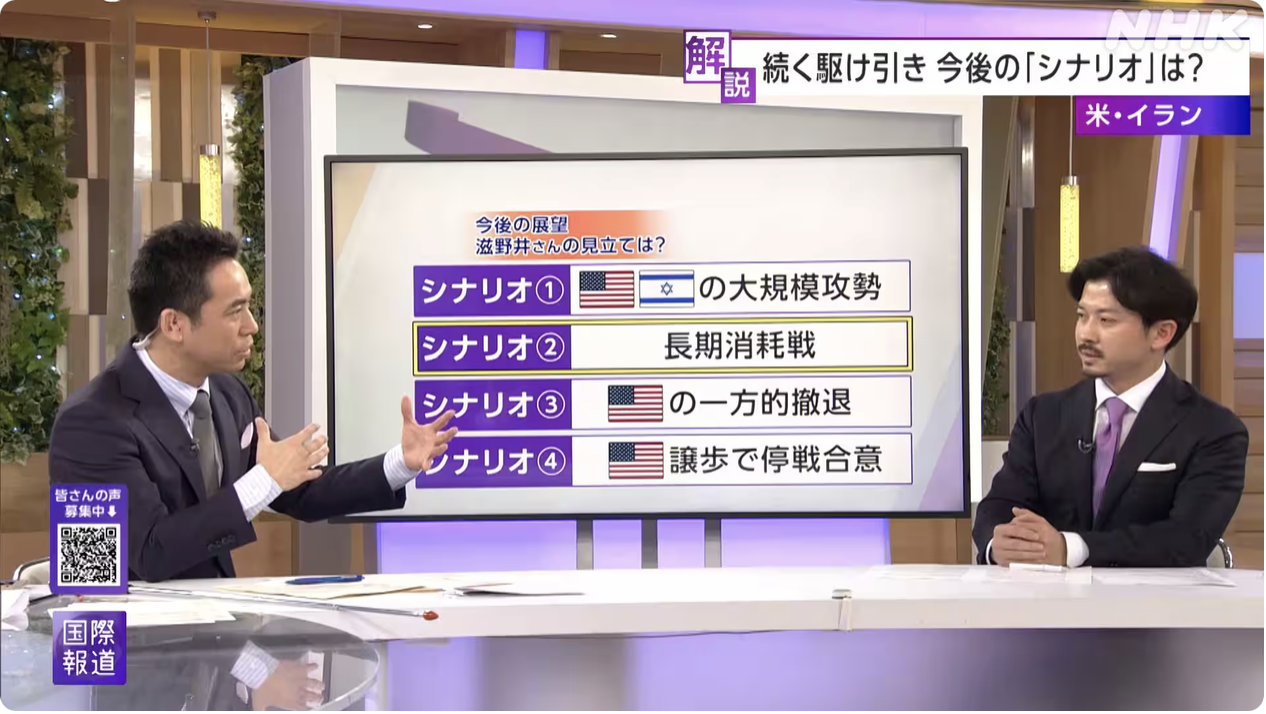
Koki Shigenoi, Visiting Member of ROLES, appeared on NHK’s International News Report 2026, broadcast on April 27, 2026, to provide analysis on the Iran War and the evolving U.S.–Iran negotiations. The segment was later published on NHK’s website on May 8, 2026, under the title “Commentary by Mr. Shigenoi on the Iran Situation: Ongoing U.S.–Iran Maneuvering and Possible Future Scenarios.”
The program examined the continuing diplomatic maneuvering between the United States and Iran, the blockade of the Strait of Hormuz and the U.S. “counter-blockade,” as well as possible future scenarios including continued conflict, ceasefire negotiations, and renewed escalation.
Shigenoi explained that a gap had existed from the outset between the positions of Iran and the United States. Iran has maintained that it will not engage in negotiations as long as the U.S. counter-blockade of the Strait of Hormuz continues, while the United States has indicated that it would be prepared to negotiate if Iran came to the designated venue for talks. Shigenoi argued that the recent developments should be understood less as a breakdown in negotiations or a move toward compromise than as part of a broader struggle for initiative in the ceasefire process.
He then outlined four possible scenarios for the conflict: a renewed large-scale offensive by the United States and Israel; a protracted war of attrition; a unilateral U.S. declaration of victory followed by withdrawal; and a ceasefire agreement based on U.S. concessions. Regarding the current situation, Shigenoi noted that the fighting between the United States and Iran had entered a state of deadlock. In this context, Iran’s de facto blockade of the Strait of Hormuz and the U.S. counter-blockade could lead to a prolonged form of military and economic attrition.
Shigenoi emphasized that a protracted war of attrition has two dimensions. The first is military attrition, involving continued low-intensity exchanges through missiles and drones. The second is economic attrition, centered on Iran’s control over the Strait of Hormuz and U.S. efforts to restrict vessels connected to Iran. Iran seeks to pressure the global economy through the Strait of Hormuz and thereby alter the behavior of the United States and Israel through external pressure. The United States, by contrast, is attempting to put pressure on Iran’s economic lifeline by restricting its oil exports.
On the question of how long Iran could withstand such pressure, Shigenoi noted that the Iranian regime has demonstrated considerable resilience against military attacks. At the same time, he argued that the economic effects of the U.S. counter-blockade may emerge with a time lag. Iran is believed to have oil already in transit or stored offshore, which means that the impact of the blockade may not be immediate. However, once the effects begin to appear, they could place significant pressure on Iran’s economy and its capacity to sustain the war.
Shigenoi also discussed Iranian Foreign Minister Abbas Araghchi’s visits to Pakistan, Oman, and Russia, describing them as a strategically calibrated diplomatic offensive. Pakistan has served as an intermediary in the U.S.–Iran ceasefire process, making it a likely channel through which Iran could convey its concerns and proposals to Washington. Oman, which shares the Strait of Hormuz with Iran, may have been involved in practical discussions over the blockade, ceasefire management, and future arrangements for maritime traffic. Russia, meanwhile, may have been approached as a potential strategic backer in future nuclear negotiations with the United States.
The program also addressed Iran’s reported proposal for a “two-stage negotiation” process. Shigenoi explained that this should be understood not as a full peace plan, but as a realistic ceasefire-management framework. Since the blockade of the Strait of Hormuz and the U.S. counter-blockade have become central obstacles to negotiations, it would be reasonable to first address these maritime issues, ease the level of fighting, and then move on to the larger and more difficult question of Iran’s nuclear program.
Finally, Shigenoi commented on the future of the so-called “Axis of Resistance,” including Hezbollah, Hamas, and the Houthis in Yemen. He argued that the fate of these Iran-backed actors will depend heavily on how the war ends. Iran is seeking an end not only to the war against itself, but also to conflicts involving Lebanon and Yemen. The United States, by contrast, is demanding that Iran end its support for proxy forces and stop coordinating with them. This issue, Shigenoi noted, remains one of the central points of contention in the ceasefire conditions advanced by Washington and Tehran.
For more details, please see the NHK segment below (in Japanese):
Commentary by Mr. Shigenoi on the Iran Situation: Ongoing U.S.–Iran Maneuvering and Possible Future Scenarios
https://www.web.nhk/tv/an/kokusaihoudou/pl/series-tep-8M689W8RVX/bl/pDAZdogaO5/bp/pglP4Zl6zg
The program examined the continuing diplomatic maneuvering between the United States and Iran, the blockade of the Strait of Hormuz and the U.S. “counter-blockade,” as well as possible future scenarios including continued conflict, ceasefire negotiations, and renewed escalation.
Shigenoi explained that a gap had existed from the outset between the positions of Iran and the United States. Iran has maintained that it will not engage in negotiations as long as the U.S. counter-blockade of the Strait of Hormuz continues, while the United States has indicated that it would be prepared to negotiate if Iran came to the designated venue for talks. Shigenoi argued that the recent developments should be understood less as a breakdown in negotiations or a move toward compromise than as part of a broader struggle for initiative in the ceasefire process.
He then outlined four possible scenarios for the conflict: a renewed large-scale offensive by the United States and Israel; a protracted war of attrition; a unilateral U.S. declaration of victory followed by withdrawal; and a ceasefire agreement based on U.S. concessions. Regarding the current situation, Shigenoi noted that the fighting between the United States and Iran had entered a state of deadlock. In this context, Iran’s de facto blockade of the Strait of Hormuz and the U.S. counter-blockade could lead to a prolonged form of military and economic attrition.
Shigenoi emphasized that a protracted war of attrition has two dimensions. The first is military attrition, involving continued low-intensity exchanges through missiles and drones. The second is economic attrition, centered on Iran’s control over the Strait of Hormuz and U.S. efforts to restrict vessels connected to Iran. Iran seeks to pressure the global economy through the Strait of Hormuz and thereby alter the behavior of the United States and Israel through external pressure. The United States, by contrast, is attempting to put pressure on Iran’s economic lifeline by restricting its oil exports.
On the question of how long Iran could withstand such pressure, Shigenoi noted that the Iranian regime has demonstrated considerable resilience against military attacks. At the same time, he argued that the economic effects of the U.S. counter-blockade may emerge with a time lag. Iran is believed to have oil already in transit or stored offshore, which means that the impact of the blockade may not be immediate. However, once the effects begin to appear, they could place significant pressure on Iran’s economy and its capacity to sustain the war.
Shigenoi also discussed Iranian Foreign Minister Abbas Araghchi’s visits to Pakistan, Oman, and Russia, describing them as a strategically calibrated diplomatic offensive. Pakistan has served as an intermediary in the U.S.–Iran ceasefire process, making it a likely channel through which Iran could convey its concerns and proposals to Washington. Oman, which shares the Strait of Hormuz with Iran, may have been involved in practical discussions over the blockade, ceasefire management, and future arrangements for maritime traffic. Russia, meanwhile, may have been approached as a potential strategic backer in future nuclear negotiations with the United States.
The program also addressed Iran’s reported proposal for a “two-stage negotiation” process. Shigenoi explained that this should be understood not as a full peace plan, but as a realistic ceasefire-management framework. Since the blockade of the Strait of Hormuz and the U.S. counter-blockade have become central obstacles to negotiations, it would be reasonable to first address these maritime issues, ease the level of fighting, and then move on to the larger and more difficult question of Iran’s nuclear program.
Finally, Shigenoi commented on the future of the so-called “Axis of Resistance,” including Hezbollah, Hamas, and the Houthis in Yemen. He argued that the fate of these Iran-backed actors will depend heavily on how the war ends. Iran is seeking an end not only to the war against itself, but also to conflicts involving Lebanon and Yemen. The United States, by contrast, is demanding that Iran end its support for proxy forces and stop coordinating with them. This issue, Shigenoi noted, remains one of the central points of contention in the ceasefire conditions advanced by Washington and Tehran.
For more details, please see the NHK segment below (in Japanese):
Commentary by Mr. Shigenoi on the Iran Situation: Ongoing U.S.–Iran Maneuvering and Possible Future Scenarios
https://www.web.nhk/tv/an/kokusaihoudou/pl/series-tep-8M689W8RVX/bl/pDAZdogaO5/bp/pglP4Zl6zg



Related News
Announcements
2026.10.01 (Thu.)
 Research Unit on the New Persian Gulf Order
Announcements
2026.07.29 (Wed.)
Announcements
2026.07.25 (Sat.)
Announcements
2026.07.07 (Tue.)
Announcements
2026.07.07 (Tue.)