

Announcements
[Panel Discussion] Koki Shigenoi Speaks at HBKU-GISR Symposium on Digital Archiving of Palestine

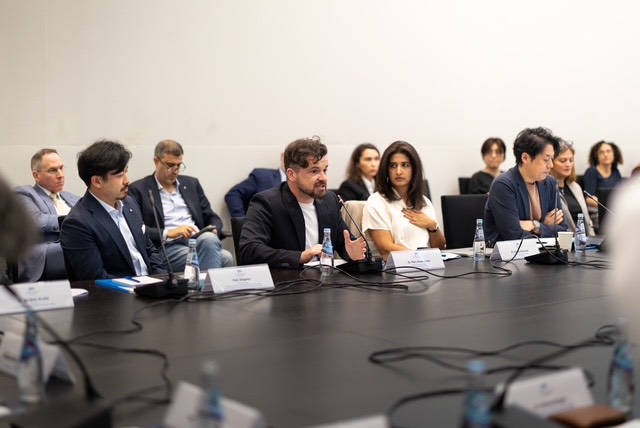
Koki Shigenoi, Visiting Member of ROLES, participated in the symposium “From Hiroshima to Gaza: A Japan-Qatar Dialogue on the Power of Documentation and Diplomacy,” hosted by the Global Institute for Strategic Research (GISR) at Hamad Bin Khalifa University, on November 3, 2025.
The symposium examined the growing importance of documentation and diplomacy in an era marked by contemporary warfare, gray-zone conflicts, disinformation, propaganda, and influence operations. By connecting Japan’s experience of preserving the memories of Hiroshima and Nagasaki with Qatar’s role in humanitarian assistance, mediation, and post-conflict recovery, the event explored how historical documentation and sustained diplomacy can help protect truth, counter erasure, and support future peacebuilding.
Shigenoi spoke in Session 2, “Archiving Palestine: Digital Repositories as Pillars of Resistance and Peace.” The session focused on the role of digital archives in preserving Palestinian history, cultural memory, and evidence against erasure, while also considering how documentation can contribute to future justice, reconciliation, and peace. The session was moderated by Sayed Ali Alavi of SOAS University of London and featured Professor Dina Matar of SOAS University of London, Hanine Shehadeh of New York University Abu Dhabi, Jamila Ghaddar of the University of Amsterdam, and Shigenoi.
In his remarks, Shigenoi introduced the University of Tokyo’s interdisciplinary team from the Graduate School of Interdisciplinary Information Studies and the Research Center for Advanced Science and Technology. The team studies war, conflict, and disasters through digital technologies, including 3D archiving, VR, AR, and metaverse-based visualization.
Shigenoi explained that the University of Tokyo’s work is closely connected to collaborations with partners in Qatar and beyond, including Al Jazeera, the Qatar Foundation’s World Innovation Summit for Health, Fighting Erasure, UNRWA, and the ICRC. While Fighting Erasure provides an academic foundation grounded in rigorous archival science, he noted that the University of Tokyo’s work is more application-oriented and advocacy-driven. In this sense, the two initiatives are complementary.
He emphasized that researchers and technology specialists based in Tokyo cannot conduct fieldwork directly in Gaza. Instead, they rely on data collected at great personal risk by journalists, researchers, citizens, humanitarian organizations, and local partners on the ground. The role of the University of Tokyo team is to use digital technology to transform such data into tools for public communication and advocacy.
Shigenoi also discussed the team’s earlier work following the outbreak of the Russia–Ukraine war, in which local collaborators provided on-site data that was preserved in 3D format and archived on a digital Earth platform. He explained that 3D reconstruction enables audiences to experience traces of destruction and everyday life through immersive media such as VR and AR, offering a different form of understanding from television or smartphone images.
He further noted that the contemporary information environment is increasingly shaped by short videos, emotional narratives, and social media-driven attention economies. In such a context, evidence-based reporting and archival materials are often overshadowed by disinformation and viral narratives. Shigenoi argued that one of the purposes of XR-based archival work is to shed light on evidence collected by journalists, researchers, and citizens, and to present it in forms that can reach wider audiences, especially younger generations.
Shigenoi also reflected on exhibitions held in Japan, where middle- and high-school students experienced XR reconstructions of damage in Ukraine and Gaza. He observed that such immersive experiences can make viewers confront destruction and traces of daily life in ways that differ fundamentally from conventional news footage. While university researchers cannot directly stop war or genocide, they can help document truth, preserve evidence for future generations, and give archival data new social meaning through digital technology.
The symposium provided an important forum for connecting Japanese and Qatari perspectives on documentation, diplomacy, and peacebuilding, and for discussing how digital archives can contribute to preserving Palestinian memory and supporting evidence-based advocacy.
For more details, please see the link below.
From Hiroshima to Gaza: A Japan-Qatar Dialogue on the Power of Documentation and Diplomacy
https://www.hbku.edu.qa/en/academic-events/GISR-FHGJQDPDD
The symposium examined the growing importance of documentation and diplomacy in an era marked by contemporary warfare, gray-zone conflicts, disinformation, propaganda, and influence operations. By connecting Japan’s experience of preserving the memories of Hiroshima and Nagasaki with Qatar’s role in humanitarian assistance, mediation, and post-conflict recovery, the event explored how historical documentation and sustained diplomacy can help protect truth, counter erasure, and support future peacebuilding.
Shigenoi spoke in Session 2, “Archiving Palestine: Digital Repositories as Pillars of Resistance and Peace.” The session focused on the role of digital archives in preserving Palestinian history, cultural memory, and evidence against erasure, while also considering how documentation can contribute to future justice, reconciliation, and peace. The session was moderated by Sayed Ali Alavi of SOAS University of London and featured Professor Dina Matar of SOAS University of London, Hanine Shehadeh of New York University Abu Dhabi, Jamila Ghaddar of the University of Amsterdam, and Shigenoi.
In his remarks, Shigenoi introduced the University of Tokyo’s interdisciplinary team from the Graduate School of Interdisciplinary Information Studies and the Research Center for Advanced Science and Technology. The team studies war, conflict, and disasters through digital technologies, including 3D archiving, VR, AR, and metaverse-based visualization.
Shigenoi explained that the University of Tokyo’s work is closely connected to collaborations with partners in Qatar and beyond, including Al Jazeera, the Qatar Foundation’s World Innovation Summit for Health, Fighting Erasure, UNRWA, and the ICRC. While Fighting Erasure provides an academic foundation grounded in rigorous archival science, he noted that the University of Tokyo’s work is more application-oriented and advocacy-driven. In this sense, the two initiatives are complementary.
He emphasized that researchers and technology specialists based in Tokyo cannot conduct fieldwork directly in Gaza. Instead, they rely on data collected at great personal risk by journalists, researchers, citizens, humanitarian organizations, and local partners on the ground. The role of the University of Tokyo team is to use digital technology to transform such data into tools for public communication and advocacy.
Shigenoi also discussed the team’s earlier work following the outbreak of the Russia–Ukraine war, in which local collaborators provided on-site data that was preserved in 3D format and archived on a digital Earth platform. He explained that 3D reconstruction enables audiences to experience traces of destruction and everyday life through immersive media such as VR and AR, offering a different form of understanding from television or smartphone images.
He further noted that the contemporary information environment is increasingly shaped by short videos, emotional narratives, and social media-driven attention economies. In such a context, evidence-based reporting and archival materials are often overshadowed by disinformation and viral narratives. Shigenoi argued that one of the purposes of XR-based archival work is to shed light on evidence collected by journalists, researchers, and citizens, and to present it in forms that can reach wider audiences, especially younger generations.
Shigenoi also reflected on exhibitions held in Japan, where middle- and high-school students experienced XR reconstructions of damage in Ukraine and Gaza. He observed that such immersive experiences can make viewers confront destruction and traces of daily life in ways that differ fundamentally from conventional news footage. While university researchers cannot directly stop war or genocide, they can help document truth, preserve evidence for future generations, and give archival data new social meaning through digital technology.
The symposium provided an important forum for connecting Japanese and Qatari perspectives on documentation, diplomacy, and peacebuilding, and for discussing how digital archives can contribute to preserving Palestinian memory and supporting evidence-based advocacy.
For more details, please see the link below.
From Hiroshima to Gaza: A Japan-Qatar Dialogue on the Power of Documentation and Diplomacy
https://www.hbku.edu.qa/en/academic-events/GISR-FHGJQDPDD



Related News
Announcements
2026.10.01 (Thu.)
 Research Unit on the New Persian Gulf Order
Announcements
2026.09.22 (Tue.)
Announcements
2026.07.29 (Wed.)
Announcements
2026.07.25 (Sat.)